High certainty
Future research is very unlikely to change the estimate of effect. You can decide with confidence.

Methodology
The international standard for rating certainty of evidence and strength of recommendations. We work with it from the inside: our CEO co-wrote part of the methodological series that defines it.
Foundation
The first: how confident are we about the effect? The second: how strong should the recommendation be? They are not the same. High-certainty evidence can still lead to a conditional recommendation, and low-certainty evidence to a strong one when the balance of benefits and harms is decisive.
GRADE forces you to spell that reasoning out and write it down. That is why the World Health Organization, Cochrane and more than a hundred organisations worldwide adopted it: not because it produces better answers, but because it produces answers you can audit.
How it is rated
Future research is very unlikely to change the estimate of effect. You can decide with confidence.
The true effect is probably close to the estimate, but it could differ in a way that matters.
Confidence in the estimate is limited. The true effect may be substantially different.
Very little confidence in the estimate. Any decision must explicitly acknowledge that uncertainty.
Evidence to Decision
Certainty of evidence is only one criterion. An evidence-to-decision framework makes the panel take a position on each of these points, in writing, before it issues the recommendation.
Is the problem a priority for the population and the system?
What is the balance between desirable and undesirable effects?
How much confidence do we have in the effect estimates?
How much variability is there in what patients consider important?
What does it cost, and what do you give up by spending there?
Does it widen or narrow gaps? Is it acceptable and implementable in context?
The Colombian single-operator cholangioscopy guideline, with the meta-analysis figures and the reason the recommendation came out conditional. Both outputs are published.
Read the caseApplication
National guidelines, scientific society guidelines, institutional protocols. If a recommendation does not state its certainty and its strength, the first challenge dismantles it.
A committee deciding what gets funded needs to know whether it is acting on high or very low certainty evidence. GRADE puts that in writing.
Rating certainty outcome by outcome usually reveals that the disagreement was not about the data, but about which outcome matters most.
GRADE-ADOLOPMENT lets you adopt or adapt existing recommendations without repeating the whole synthesis, documenting what changed and why.
Our practice
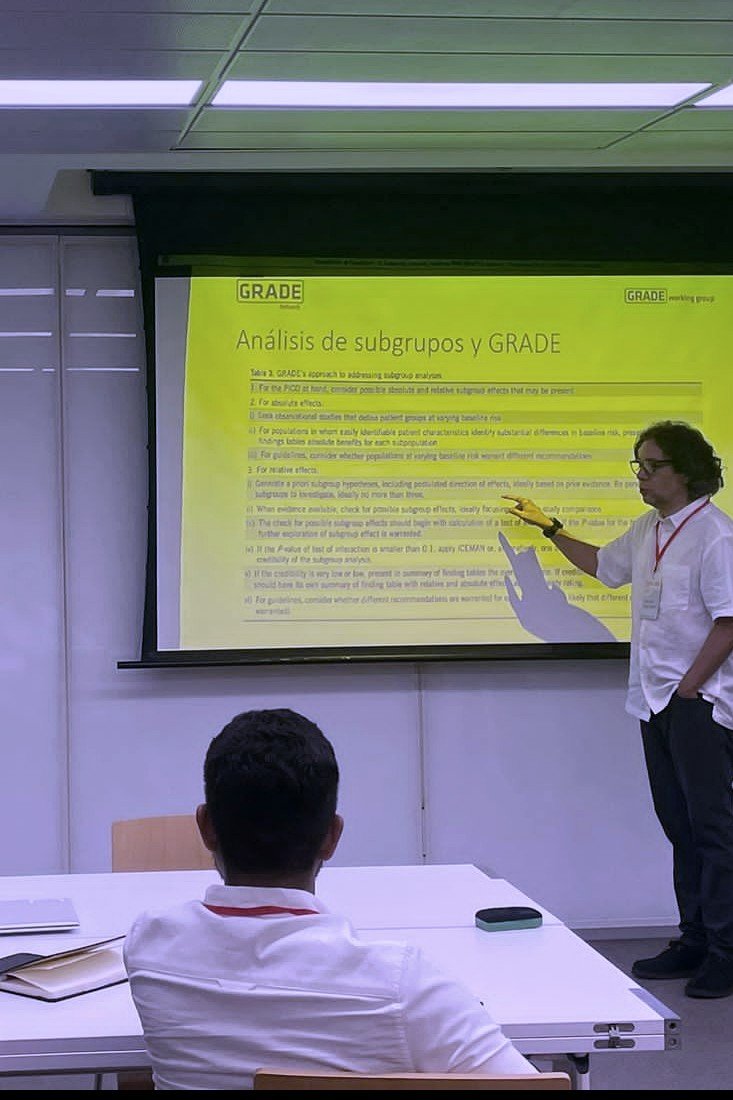
GRADE publishes its guidance as a numbered series in Journal of Clinical Epidemiology. Our CEO co-wrote articles 19 and 20 of that series and the GRADE-ADOLOPMENT framework, now the standard procedure for adopting and adapting existing guidelines.
That changes the conversation: we are not interpreting a handbook, we helped write it. When a borderline case appears, and it always does, we know the methodological intent behind the rule, not just its wording.
That method went on to shape the ARIA-EAACI, American Society of Hematology and World Allergy Organization guidelines, and the adaptation of chronic kidney disease guidelines to the Saudi context.
He directs the Colombia GRADE Network and works with the World Health Organization in Geneva as methodologist for the iCAM guideline. From 2022 to 2026 he sat on its Guideline Review Committee, which reviews and approves WHO guidelines. He also co-wrote the WHO Europe manual on contextualising guidelines (2023) and the PAHO guide to adapting guidelines (2023).
Structured facilitation, documented voting and formal management of conflicts of interest.
Summary of Findings tables and complete GRADE profiles, reproducible and ready for publication.
Applied GRADE workshops built on your institution's own documents and questions, with assessment and a certificate of successful completion. The GRADE Working Group does not issue individual certifications; structured courses with assessment are the international standard.
Thirty minutes with one of our methodologists, to look at your case and work out whether GRADE is the right framework.